Manufacturer > Boston Scientific > Devices > MACH 1™ Guide Catheter

MACH 1™ Guide Catheter

Device-Type

Guiding Catheters

Targated Speciality

Endovascular

Manufacturer

Boston Scientific


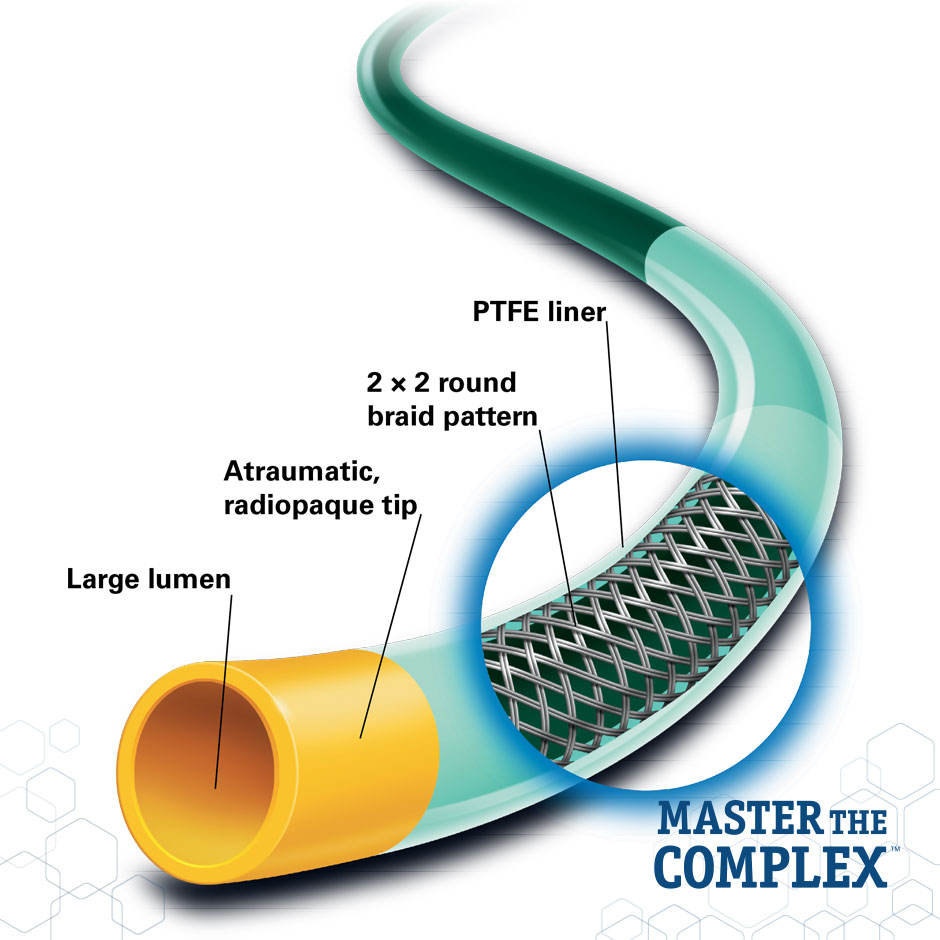
A large lumen and optimal shaft performance offers precise handling, device delivery options and clinical versatility.

Features and Benefits

Unique Polymer

  • Enhances back-up support and curve retention

Large Lumen Design

  • Offers the device compatibility needed for a multitude of treatment options and treatment scenarios
  • Enables catheter downsizing
  • Provides improved dye flow for better visualization

Design and Performance Dynamics

  • Softer shaft guide catheter designed for active users accustomed to deep seating
  • Available in 6F (0.070"), 7F (0.081") and 8F (0.091") sizes

Safety informations

INDICATIONS FOR USE

Boston Scientific Guide Catheters provide a pathway through which medical instruments, such as balloon dilatation catheters, guide wires or other therapeutic devices, may be introduced.These devices are not intended for use in the cerebral vasculature. Boston Scientific Peripheral Guide Catheters are intended for use in general intravascular and peripheral applications. Boston Scientific Coronary Guide Catheters are intended for use in general intravascular and coronary applications.


CONTRAINDICATIONS

None known.


WARNINGS

Guide catheters are designed for use by physicians engaged in the practice of a specialized branch of medicine. Use of these devices should be restricted to those specialists trained to perform the procedure. A thorough understanding of the technical principles, clinical applications, and risks associated with angioplasty is necessary before performing this procedure.
Potential adverse events

Potential adverse reactions which may result from the use of this device include but are not limited to:

  • Access site pain
  • Vessel trauma including dissection or perforation
  • Hemorrhage or hematoma
  • Impaired blood flow due to thrombosis, embolism, or vasospasm that could lead to myocardial infarction, transient ischemic attack (TIA), or stroke
  • Allergic reaction
  • Trauma that could lead to surgical intervention
  • Pseudoaneurysm
  • Infection
  • Death


Questions & Answers


Don't see the answer you're looking for ?