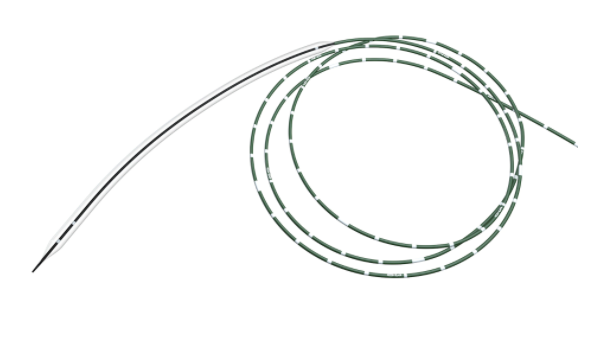
Indications for Use
ULTRAVERSE® 014 and ULTRAVERSE® 018 PTA Dilatation Catheters are recommended for use in percutaneous transluminal angioplasty (PTA) of the renal, popliteal, tibial, femoral, and peroneal arteries. These catheters are not for use in coronary arteries.
Contraindications
None known.
Warnings
1. Contents supplied STERILE using ethylene oxide (EO). Non-pyrogenic. Do not use if sterile barrier is opened or damaged. Do not reuse, reprocess or resterilize.
2. This device has been designed for single use only. Reusing this medical device bears the risk of cross-patient contamination as medical devices – particularly those with long and small lumina, joints, and/or crevices between components – are difficult or impossible to clean once body fluids or tissues with potential pyrogenic or microbial contamination have had contact with the medical device for an indeterminable period of time. The residue of biological material can promote the contamination of the device with pyrogens or microorganisms which may lead to infectious complications.
3. Do not resterilize. After resterilization, the sterility of the product is not guaranteed because of an indeterminable degree of potential pyrogenic or microbial contamination which may lead to infectious complications. Cleaning, reprocessing and/or resterilization of the present medical device increases the probability that the device will malfunction due to potential adverse effects on components that are influenced by thermal and/or mechanical changes.
4. To reduce the potential for vessel damage, the inflated diameter and length of the balloon should approximate the diameter and length of the vessel just proximal and distal to the stenosis.
5. When the catheter is exposed to the vascular system, it should be manipulated while under high-quality fluoroscopic observation. Do not advance or retract the catheter unless the balloon is fully deflated. If resistance is met during manipulation, determine the cause of the resistance before proceeding. Applying excessive force to the catheter can result in tip breakage or balloon separation.
6. Do not exceed the RBP recommended for this device. Balloon rupture may occur if the RBP rating is exceeded. To prevent over pressurization, use of a pressure monitoring device is recommended.
7. After use, this product may be a potential biohazard. Handle and dispose of in accordance with acceptable medical practices and applicable local, state and federal laws and regulations.
8. The safety and effectiveness of the device has not been established, or is unknown, in vascular regions other than those specifically indicated.
Precautions
1. Refer to accessory IFU for potential access site warnings, precautions, and adverse events.
2. Carefully inspect the catheter prior to use to verify that catheter has not been damaged during shipment and that its size, shape and condition are suitable for the procedure for which it is to be used. Do not use if product damage is evident.
3. The ULTRAVERSE® 014 and ULTRAVERSE® 018 PTA Balloon Dilatation Catheters shall only be used by physicians trained in the performance of percutaneous transluminal angioplasty.
4. The minimal acceptable sheath French size is printed on the package label. Do not attempt to pass the PTA catheter through a smaller size introducer sheath than indicated on the label.
5. Do not remove the guidewire in situ to shoot contrast through the wire lumen or perform a wire exchange. If the wire is removed while the balloon catheter is situated in tortuous anatomy, the risk of kinking the catheter is increased.
6. Use the recommended balloon inflation medium (25% contrast medium/75% sterile saline solution). It has been shown that a 25/75% contrast / saline ratio has yielded faster balloon inflation / deflation times. Never use air or other gaseous medium to inflate the balloon.
7. If resistance is felt during post procedure withdrawal of the catheter through the introducer sheath, determine if contrast is trapped in the balloon with fluoroscopy. If contrast is present, push the balloon out of the sheath and then completely evacuate the contrast before proceeding to withdraw the balloon.
8. If resistance is still felt during post procedure withdrawal of the catheter, it is recommended to remove the balloon catheter and guidewire / introducer sheath as a single unit, and replace the previously used balloon catheter with a new balloon. Exercise caution when removing the device.
9. Do not continue to use the balloon catheter if the shaft has been bent or kinked. Do not excessively bend, twist, or alter the shape of the device as it may compromise the integrity of the hydrophilic coating.
10. Prior to re-insertion through the introducer sheath, the balloon should be wiped clean with wet gauze and rinsed with sterile normal saline. Avoid excessively wiping the coated portions of the device, or wiping with dry gauze, as this may damage the hydrophilic coating.
11. Balloon re-wrapping should only occur while the balloon catheter is supported with a guidewire or stylet.
12. This device is coated with a hydrophilic coating at the distal segment of the shaft and the balloon. Please refer to the Directions for Use section for further information on how to prepare and use this device to ensure it performs as intended. Failure to abide by the warnings in this labeling might result in damage to the hydrophilic coating, which may require intervention or result in serious adverse events.